Social media marketing for marine mechanics decides whether a boat owner with an engine problem finds your workshop first, or scrolls past to whichever mechanic’s page shows more recent work and faster replies. A breakdown or a pre-season service is an urgent, trust-sensitive decision: owners want proof of competence — before-and-after repair photos, visible certifications, real reviews — before they hand over an engine worth tens of thousands of euros. Marine Marketing International runs this discipline as a complete system — repair documentation that proves competence, seasonal maintenance reminders timed to winterisation and spring commissioning, and a reply protocol built for the urgency a breakdown creates. We maintain a live charter fleet on boatrentalbalearics.com, so every reliability and turnaround message here is tested against our own boats, not theorised.
Fast facts
- This social media programme for marine mechanics, run by Marine Marketing International, starts from €4,500 for build, with ongoing management typically €1,000 to €2,500 a month.
- MMI maintains a live charter fleet on boatrentalbalearics.com, so every reliability and turnaround message is tested against real maintenance schedules first.
- A boat owner searching for a mechanic is usually urgent: reply speed and visible proof of competence decide who gets the call, not the prettiest logo.
- Every social media marketing programme ships with a before-and-after content plan, seasonal maintenance reminders and monthly reporting as standard.
Why social media marketing matters for marine mechanics
Most workshop enquiries start from urgency, not browsing: an engine that will not start the morning before a trip, a survey that flags a repair before a sale can close. A boat owner in that position searches fast and picks the workshop that looks most competent and most responsive right now, and social media is increasingly where that first impression forms. Generic social media management, an occasional workshop photo, does nothing to prove the competence an owner is actually screening for.
The practical consequences follow. Content needs to show real work — before-and-after photos, diagnostic detail, technician certifications — because an owner comparing workshops is looking for evidence, not adjectives. Posts need a route to a same-day callout or booking, not just a like. And reviews need active management, because a boat owner searching for an emergency mechanic checks recent reviews before they check anything else.
Consider two workshops with similar skill and similar capacity. The one running a structured programme converts a materially higher share of searches into booked jobs, because every post and reply is built to prove competence to a stranger deciding fast. The other posts occasionally and relies on word of mouth, missing every owner who searched online first and found a thin, outdated feed.
What makes a boat owner trust a workshop enough to call
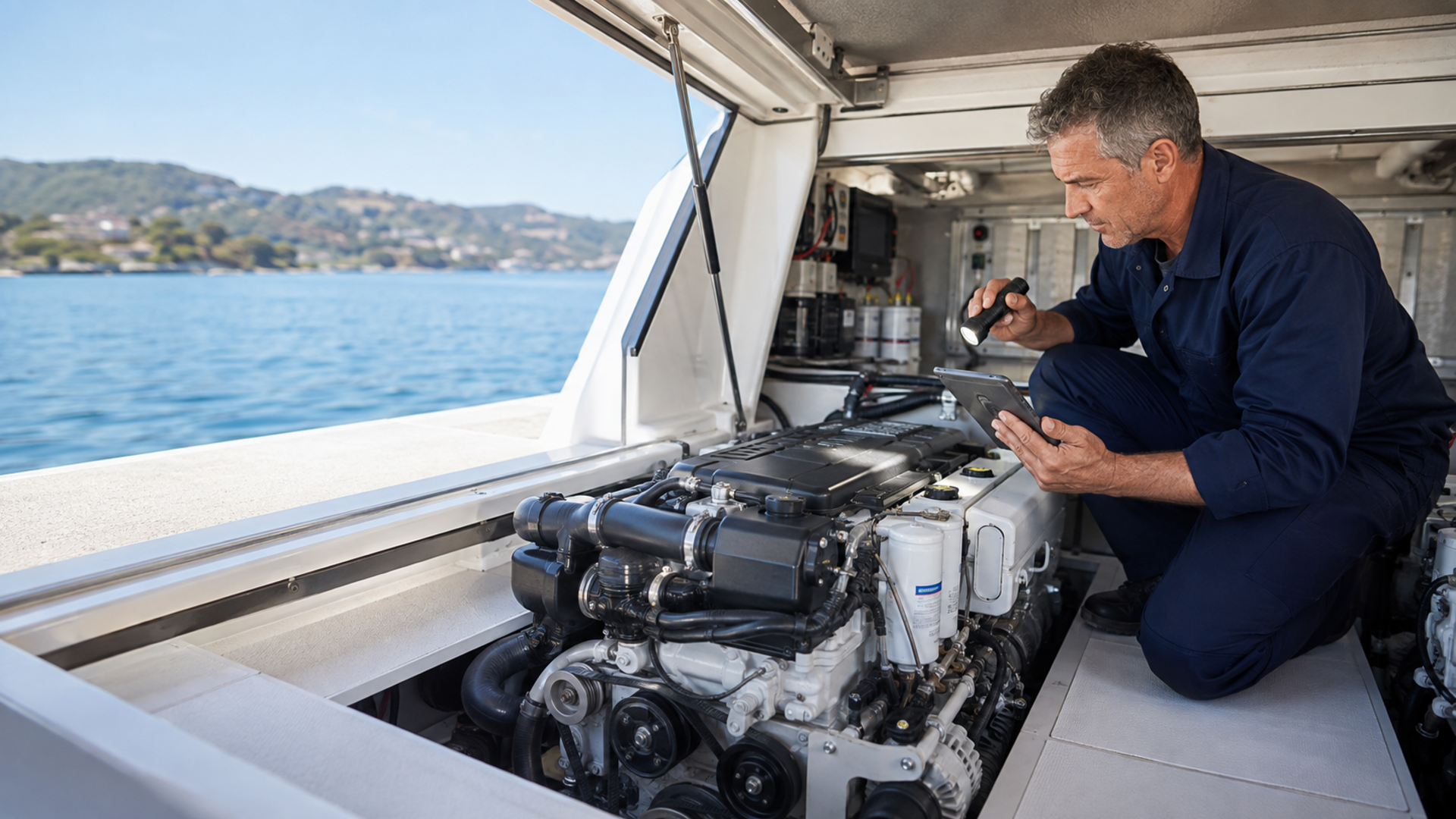
An owner scrolling a mechanic’s page is judging competence and honesty as much as price — a clear before-and-after photo, a technician visibly certified on the engine brands they service, a caption that explains what actually went wrong, rather than vague marketing language. Photography and video of real diagnostic and repair work, not stock engine-room images, are what a workshop feed is judged on first.
What moves a browsing owner to a call is speed and specificity. A post naming the brands and systems the workshop actually services, a caption answering the obvious “can you fit us in” question, a reply to a DM within the hour during business hours — each signals a workshop that will actually pick up the phone during a breakdown. Boat owners facing an urgent repair rarely wait for a slow reply; they call the next name on the list.
This is why the discipline cannot be delegated to a generalist social media manager posting generic marina photography on a fixed schedule. The content, cadence and reply speed that convert followers into booked jobs are specific to how repair and maintenance decisions are actually made, and rarely understood outside the trade itself.
Reviews carry outsized weight in this sector. A workshop with a steady stream of recent, specific reviews — not just star ratings but detail about the actual repair — reassures an anxious owner in a way no amount of paid advertising can match; prompting satisfied customers for a review is one of the highest-return actions in the whole programme, and one most workshops still leave to chance.
Seasonality also shapes the calendar. Enquiry volume spikes twice a year, once in spring as owners commission boats for the season and again in autumn as winterisation looms, and a workshop that saves its heaviest content push and its fastest reply staffing for those windows earns more per hour of effort than one running flat all year.
The anatomy of a channel that books jobs, not just followers
The trust-winning machinery is specific to marine mechanics. A content calendar built around real work — before-and-after documentation of actual jobs, diagnostic explainer content, seasonal maintenance reminders timed to winterisation and spring commissioning. Certifications and brand partnerships, Volvo Penta, Yamaha, Mercury and similar, displayed prominently and kept current. A reply protocol that answers callout and booking questions within the hour during business hours, because urgency is the default state of most enquiries. And review generation built into every completed job, not left to chance.
Around that machinery sits the content owners actually respond to: short video walkthroughs of a tricky repair explained in plain language, workshop and technician profiles that put a face to the business, and seasonal reminder posts that catch owners before a problem becomes urgent. This is where our digital marketing for marine mechanics work and our social channels overlap deliberately: paid and organic both proving the same competence to the same searching owner.

The content engine: your real booking channel
Most workshops treat social media as an afterthought when it is, in practice, where a growing share of owners check before calling — before the phone rings, before the quote request. A programme that treats the channel as a proof-of-competence engine outperforms an occasional, unplanned presence.
Ours is engineered around a proven anatomy: a before-and-after content calendar drawn from real jobs, certification and brand-partnership display kept current, and review generation built into the handover process for every completed job. Around the engine sits machinery owners never see: UTM-tagged links from bio to booking form, saved-reply templates for the callout and pricing questions that repeat constantly, and monthly reporting that separates genuine booking enquiries from vanity engagement.
Local search and social reinforce each other here more than in most sectors. A strong, active social presence supports the Google reviews and local search visibility that decide who appears first when an owner searches for a marine mechanic nearby at the worst possible moment, so the two channels should always be planned together, not separately.
What better social media marketing is worth, in numbers
The commercial case for social media marketing for marine mechanics is not folklore; it is measured. Stanford’s web-credibility research found that around 75% of users judge a company’s credibility from its design and presentation alone — for a workshop, that judgment decides whether an anxious owner trusts a stranger with an expensive engine. Google’s own research puts the first visual impression at about 50 milliseconds, and found that 53% of mobile visitors abandon pages that take longer than three seconds to load; industry conversion studies consistently price each extra second of delay at roughly 7% of conversions, a cost that applies just as directly to a slow-loading booking link during an urgent search. In workshop terms the arithmetic is direct: a single repair job can be worth several hundred to several thousand euros, so if a better-run programme wins even one additional job a week, it repays the programme cost many times over inside a single month.
These returns compound in a way an unmanaged feed cannot. A well-run programme keeps building a documented track record as the content calendar matures, converting a rising share of urgent searches into booked jobs as the review count and content library grow, while a stale feed drifts the other way as owners default to whichever competitor looks more active and more trusted. That gap widens every season a workshop leaves its feed untouched, because reviews and content both compound while a stale page simply ages.
The same arithmetic works in reverse. A workshop with no visible channel is not simply invisible online, it is absent from the split-second comparison an anxious owner makes between three or four names before picking up the phone, and that comparison happens whether or not the workshop is part of it. Multiply that missed comparison across a full season of breakdowns and pre-purchase surveys, and the lost revenue dwarfs the modest monthly cost of running the channel properly.
What an MMI project includes
One accountable programme for marine mechanics: channel strategy and a before-and-after content calendar; certification and brand-partnership display; reply protocols built for urgency; review generation built into the job-completion process; seasonal maintenance reminder content; and monthly reporting tied to booked jobs, not just likes. Programme build starts from €4,500 with management typically €1,000 to €2,500 a month, priced fixed and quoted in writing before work begins. First-year setup includes a full review-generation workflow built into the job handover, at no extra charge.
After the initial build, most workshops keep us managing the channel year-round, documenting new jobs as they happen and timing seasonal content to winterisation and commissioning windows. Read our story to see why that stewardship model exists.

Proven on our own maintained fleet
We do not ask workshops to trust a portfolio in the abstract. We maintain a live charter fleet on boatrentalbalearics.com, and every reliability, turnaround and reply-speed standard we recommend is one we hold our own maintenance partners to first. Standards and market context come from the industry bodies we follow — NMMA, ICOMIA and British Marine — not generic marketing folklore.
That operating experience is also why our scopes are precise: we know which content actually books jobs for a given workshop’s specialism and capacity, which posts turn an anxious searcher into a confident caller, and we quote every proposal itemised against outcomes rather than deliverable jargon. We track every enquiry back to the post or reply that produced it, so the reporting we send is a record of booked jobs, not a list of impressions delivered, and every recommendation we make has already been tested on our own maintenance schedule before it reaches a client account.