Marketing digitale per porti turistici decides whether an empty berth fills with a paying annual contract, or sits vacant for another season while a boat owner books a slip down the coast instead. A marina sells two very different products at once — long-term annual berths and short-term transient stays — and each needs its own channel timing and message. Marine Marketing International runs digital marketing for marinas as a single connected system: paid search and social that reach boat owners exactly when they are berth-shopping, retargeting that recovers the visitor who checked availability and left, and email sequences that convert a waitlist into signed contracts. We operate marine platforms of our own — boatrentalbalearics.com, brokerbarche.com and yachtbrokersgreece.com — so every channel recommendation here is tested on live enquiry flow, not theorised.
In breve
- Digital marketing for marinas by Marine Marketing International starts from €4,500, with monthly programmes typically €1,200 to €3,500 depending on berth count and transient volume.
- MMI operates its own marine platforms — boatrentalbalearics.com, brokerbarche.com and yachtbrokersgreece.com — so every channel we recommend is proven on live enquiry flow first.
- A marina sells annual berths and transient stays at once; digital marketing for marinas has to target each with its own timing and message.
- Every MMI digital marketing for marinas programme ships with paid, email and retargeting working from one shared view of berth availability, not three disconnected tools.
Why digital marketing for marinas is its own discipline
A marina does not sell one product to one buyer type; it sells annual berths to owners planning a full season and transient stays to boaters passing through on a given week, and generic small-business marketing rarely separates the two. Digital marketing for marinas has to run two campaigns in parallel — a longer-cycle programme aimed at owners renewing or switching berths, and a fast-moving one aimed at transient boaters searching for a slip on short notice.
The practical consequences follow from that split. Annual-berth campaigns need to run months ahead of contract renewal season, reaching owners while they are still deciding whether to stay or move. Transient campaigns need to be immediate, showing live availability to a boater searching this week, because a slow response sends that booking to the next marina down the coast. And email has to segment by berth type and boat length, because a 12-metre sailing yacht owner and a 20-metre motor yacht owner are shopping for very different things.
Consider two marinas with similar berth counts. The one running digital marketing for marinas as a connected system reaches renewing owners early and captures transient bookings the same day a boater starts searching. The other relies on word of mouth and a static website, and loses both audiences to whichever marina answered first.
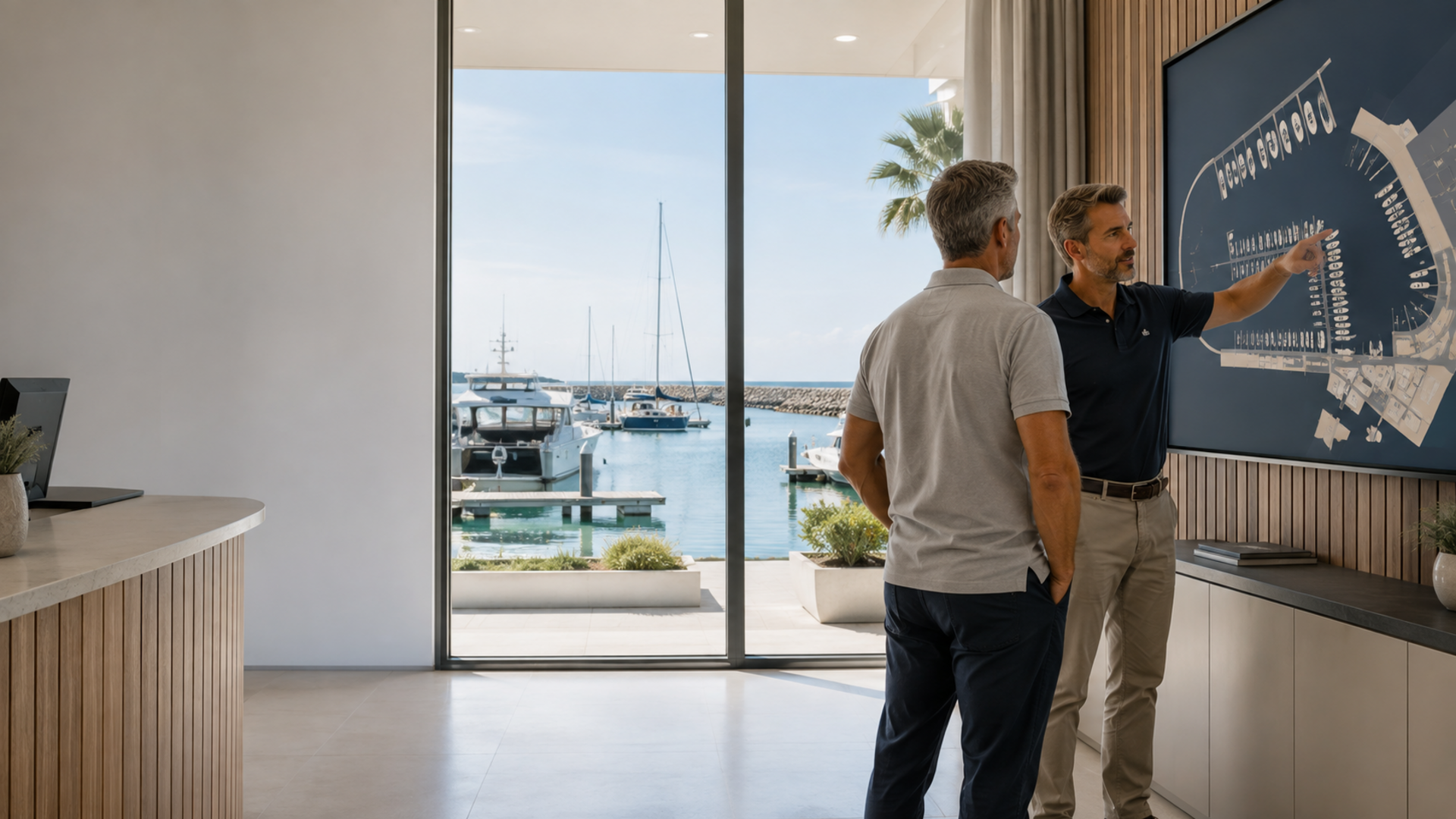
What boat owners judge before they enquire
An owner scrolling a retargeting ad or opening a berth-availability email is running the same trust check as someone landing on your website cold: does the availability look current, does the pricing look real, and does this marina feel well managed. Inconsistent presentation across channels — a smart paid ad linking to a stale berth list — costs credibility the moment the click lands on outdated information.
Transient boaters judge speed above everything else. A boater searching for tonight's berth on their phone will not wait for a callback; they need live availability and a bookable slip within minutes, and a marina whose digital presence cannot answer that in real time loses the booking to whichever marina can.
Both audiences are also judging responsiveness. An owner who enquires about an annual berth expects a reply inside the day, particularly during renewal season; a transient boater expects near-instant confirmation. Digital marketing for marinas that drives enquiries but ignores response time is only half finished.
This split matters most in shoulder-season weeks, when a marina is simultaneously chasing next year's annual renewals and this week's transient boaters. Running both audiences through one undifferentiated campaign wastes budget on owners who are not yet ready to decide and under-serves boaters who need an answer today. Separating the two tracks, with their own timing, creative and landing pages, is what actually lets a marina compete for both revenue streams at once instead of quietly under-serving one of them.
The anatomy of a digital marketing programme that fills berths
The berth-filling machinery is specific to marina operations. A live feed connecting berth availability to paid search and social, so campaigns emphasise open slips rather than berths already under contract. Retargeting segmented by berth type and boat length, following the exact availability a visitor viewed rather than a generic marina ad. Email sequences triggered by renewal dates and waitlist behaviour — a contract expiring in ninety days, a boater who checked availability twice — instead of a single seasonal newsletter. And a CRM that logs every enquiry against the berth and boat length that produced it, so the marina can see which channels actually fill capacity.
Around that machinery sits the creative layer: marina photography and drone footage repurposed correctly for each channel, ad copy that leads with berth size and depth because that is what owners scan for first, and landing pages built to convert rather than just display amenities. This is where our realizzazione siti web nautici work and our digital marketing work overlap deliberately: a marina site built to convert gives every paid click somewhere worth landing.

The berth waitlist: your real revenue engine
Most marina marketing spend is wasted on generic brand awareness when the real revenue engine is the berth waitlist: the pipeline of owners and boaters ready to sign the moment a slip opens. Digital marketing for marinas that treats every channel as a route into that waitlist outperforms marketing that treats each channel as its own campaign.
Ours is engineered around a proven anatomy: a live berth-availability feed powering paid and social so ad spend never chases a slip already under contract; retargeting that follows the specific berth type and length a visitor viewed, not a generic marina banner; email sequences that resurface an opening the moment it appears against a matched waitlist entry; and a landing page for every berth type built to convert, not just display amenities. Around the waitlist sits machinery owners never see: UTM tracking on every link, a CRM that attributes each enquiry to its source berth and channel, and monthly reporting that shows which berth types and which channels are actually converting.

Quanto vale un migliore marketing digitale, in cifre
The commercial case for digital marketing for marinas is not folklore; it is measured. Stanford’s web-credibility research found that around 75% of users judge a company’s credibility from its website design alone, and an ad or email that lands an owner on a weak enquiry page wastes the click that earned it. Google’s research puts the first visual impression at about 50 milliseconds, and found that 53% of mobile visitors abandon pages that take longer than three seconds to load; industry conversion studies consistently price each extra second of delay at roughly 7% of conversions, a cost every paid click pays twice if the enquiry page is slow. For a marina, the arithmetic is direct: a single annual berth contract can be worth several thousand euros, so if better-targeted digital marketing for marinas converts even one additional signed contract a quarter, it repays a €4,500 campaign several times over — before counting the transient revenue captured along the way.
These returns compound in a way a single boosted post cannot. A retargeting audience built correctly keeps recovering browsing owners month after month, and a waitlist nurtured by email keeps converting long after the original ad spend for a given opening has ended. Marinas that invest in the full system find occupancy climbs steadily as the connected channels mature.
The same arithmetic works in reverse. A marina running disconnected, one-off campaigns is not simply spending inefficiently, it is quietly losing owners to a competing marina whose paid, social and email all point at the same live availability. That loss rarely shows up as a single bad month; it shows up as a slowly rising vacancy rate nobody traces back to the marketing.
What an MMI digital marketing for marinas project includes
One accountable programme: berth-availability feed integration for paid search and social; retargeting audiences segmented by berth type and boat length; behaviour-triggered email sequences for renewals and waitlists; a landing page template built to convert for every berth type; CRM and UTM tracking tying every enquiry to its source; and monthly reporting tied to signed contracts and occupancy, not impressions. Projects start from €4,500 and are priced fixed, in writing, before work begins.
After the initial build, most marinas keep us running the channels monthly, adjusting pacing around the renewal calendar and tightening targeting as the data accumulates. Read la nostra storia per scoprire perché esiste questo modello di gestione continuativa.

Scope creep is the other quiet cost in marina marketing. Without one accountable programme, it is common to find a local agency running social, a separate freelancer running paid search, and nobody owning the waitlist at all — three invoices, three sets of creative, and no shared view of which channel actually converts a browsing owner into a signed contract. Consolidating the channels under one connected programme removes that overhead and gives the marina a single monthly report worth reading.
Testato sulle nostre piattaforme nautiche
We do not ask marinas to trust a portfolio in the abstract. We operate boatrentalbalearics.com, brokerbarche.com and yachtbrokersgreece.com, and our own enquiry funnels compete for the same owners and boaters yours do. When we specify a retargeting structure or an email sequence in a client programme, it is the version that won on our own platforms after the losing versions cost us real enquiries. Standards and market context come from the industry bodies we follow — ICOMIA, Marina Britannica e European Boating Industry — non semplice folklore di marketing.
That operating experience is also why our scopes are precise: we know which channels actually fill berths for a given marina size and mix, which produce signed contracts, and which are merely activity, and we quote every proposal itemised against outcomes rather than deliverable jargon. We track every enquiry back to the berth and channel that produced it, so the reporting we send is a record of occupancy, not a list of posts published.