Marketing digital para mecánicos navales decides whether the owner with a dead engine the day before a launch calls your workshop first, or scrolls past you to whoever ranks and responds fastest. Boat repair demand is a mix of planned haul-out work and urgent, same-week emergencies, and each needs its own channel and message. Marine Marketing International runs digital marketing for marine mechanics as a single connected system: local paid search that wins the urgent-repair moment, retargeting that recovers the owner who requested a quote, and email that keeps annual service and haul-out contracts on the calendar. We operate boatrentalbalearics.com, brokerbarche.com and yachtbrokersgreece.com, so every channel recommendation here is tested on our own live campaigns, not theorised.
Datos rápidos
- Digital marketing for marine mechanics by Marine Marketing International starts from €4,500, with monthly programmes typically €1,000 to €2,800 depending on service range and coverage area.
- MMI operates its own marine platforms — boatrentalbalearics.com, brokerbarche.com and yachtbrokersgreece.com — so every channel we recommend is proven on live campaigns first.
- Boat repair demand splits between planned haul-out work and urgent same-week emergencies; digital marketing for marine mechanics has to serve both at once.
- Every MMI digital marketing for marine mechanics programme ships with local paid, email and review management working from one shared enquiry pipeline, not three disconnected tools.
Why digital marketing for marine mechanics is its own discipline
A workshop does not sell one job type; it splits between owners planning an annual haul-out weeks in advance and owners with an engine that failed this morning and a charter booked for tomorrow. Generic small-business marketing treats every enquiry the same way; digital marketing for marine mechanics has to run two campaigns in parallel — a planned-work programme reaching owners ahead of the season, and a fast, local paid-search programme built to win the emergency search the moment it happens.
The practical consequences follow from that split. Local paid search needs to be always-on and mobile-optimised, because an owner searching for an emergency repair is doing it from the marina on a phone, not researching from a desktop days in advance. Email and haul-out reminders need to run months ahead of the season, because that work is booked early by owners who plan. And reviews matter more here than in almost any other marine niche, because a stranded owner has no time to compare portfolios — they pick whoever has the most recent five-star reviews and answers the phone.
Consider two workshops with similar capability. The one running digital marketing for marine mechanics as a connected system wins the urgent search because it ranks locally and answers fast, and fills its haul-out calendar early because reminder emails go out months ahead. The other relies on word of mouth alone and loses both the urgent job, to whichever workshop appears first in a panicked search, and the planned haul-out, to whoever reminded the owner first.
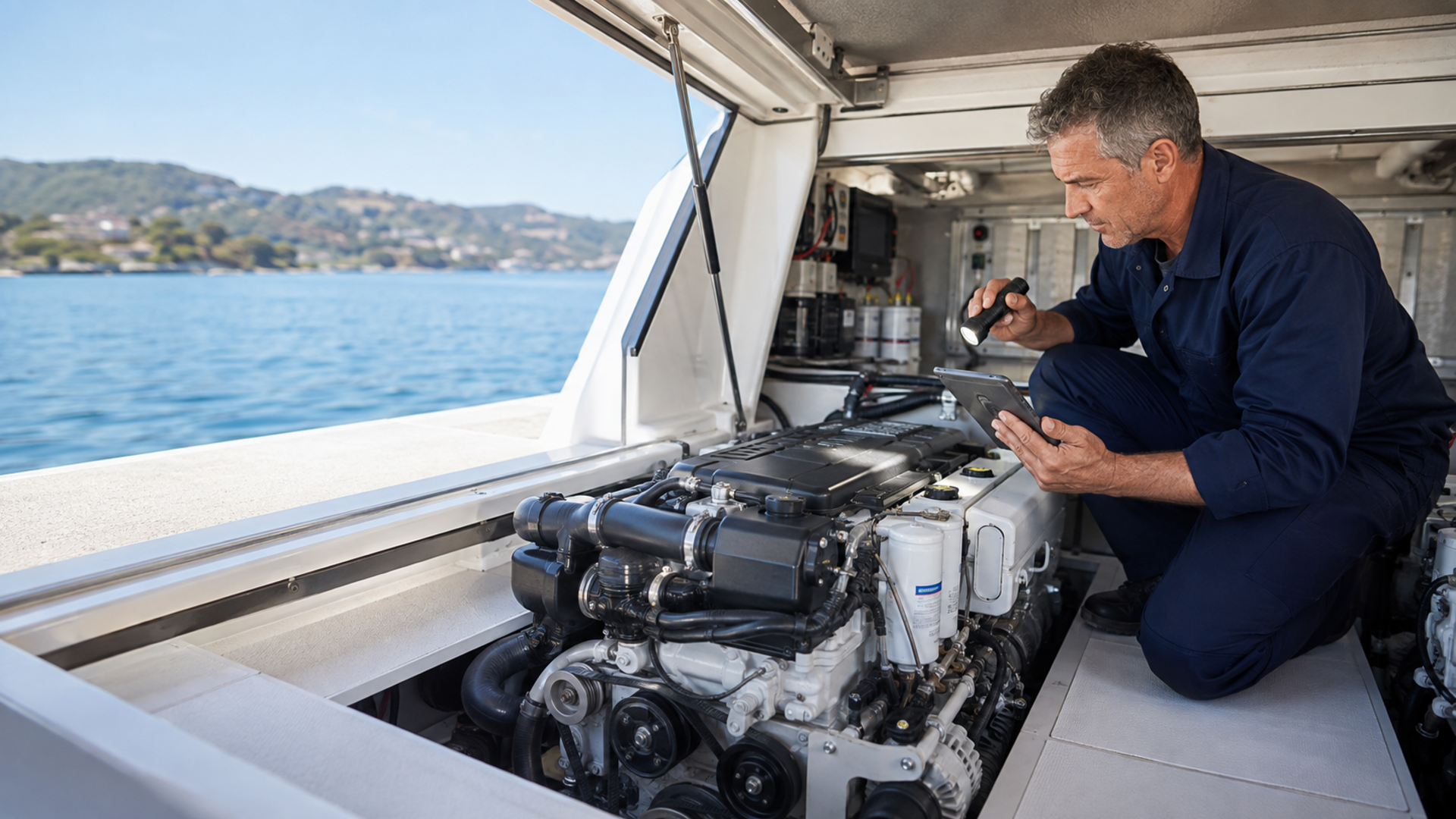
What owners judge in an urgent-repair moment
An owner searching for an emergency repair judges almost entirely on speed and proof: does this workshop show up near the top of a local search, do the reviews look recent and credible, and is there a phone number they can call right now. A workshop whose digital presence cannot answer those three questions in seconds loses the job to a competitor who can, regardless of actual repair quality.
Owners planning haul-out work judge more like a considered buyer: certifications, brand authorisations, and a service history they can trust with a bigger job. A reminder email or retargeting ad that lands on a thin, dated site undoes the credibility the planned-work campaign worked to build.
Both audiences are also judging responsiveness. An urgent enquiry needs a reply within minutes, not hours; a haul-out booking needs confirmation within the day. Digital marketing for marine mechanics that drives enquiries but ignores response time is only half finished, since a stranded owner moves to the next result the moment the first one goes unanswered.
This urgency premium is easy to underestimate until it costs a workshop a job. A charter guest whose engine fails the night before departure, or a delivery skipper stranded mid-passage, is not comparing five workshops carefully; they are calling whoever answers first and looks credible in the search result. A workshop that has invested in ranking and answering that exact moment captures work a slower competitor never even sees.
The anatomy of a digital marketing programme that fills the bay
The bay-filling machinery is specific to workshop demand. Always-on local paid search optimised for mobile and "near me" intent, so the workshop appears the moment an urgent search happens. Retargeting segmented by service type, following the owner who requested a quote rather than a generic brand ad. Email and SMS sequences triggered by haul-out season and past service history, instead of a single seasonal newsletter. And active review management, because a five-star review published this month outweighs ten from three years ago in an urgent decision.
Around that machinery sits the technical layer: fast-loading, mobile-first pages, because an owner searching from a marina on patchy signal abandons a slow page in seconds, and a clear call button that keeps the visitor moving instead of dead-ending on a contact form. This is where our diseño de sitios web marinos work and our digital marketing work overlap deliberately: a workshop site built right gives every channel somewhere worth landing.

The quote-request funnel: your real revenue engine
Most workshop marketing spend is wasted on generic brand awareness when the real revenue engine is the quote-request funnel: the path from an urgent local search or a haul-out reminder to a booked bay. Digital marketing for marine mechanics that treats every channel as a route into that funnel outperforms marketing that treats each channel as its own campaign.
Ours is engineered around a proven anatomy: always-on local paid search tuned for urgent, mobile intent so the workshop appears the moment it matters; retargeting that follows the specific service an owner enquired about, not a generic brand ad; email and SMS sequences that resurface a haul-out reminder against the owner's actual service history; and active review management that keeps the most recent, most credible proof in front of a panicked searcher. Around the funnel sits machinery owners never see: UTM tracking on every link, a CRM that attributes each enquiry to its source and channel, and monthly reporting that shows which services and which channels are actually filling the bay.

What better digital marketing is worth, in numbers
The commercial case for digital marketing for marine mechanics is not folklore; it is measured. Stanford’s web-credibility research found that around 75% of users judge a company’s credibility from its website design alone, and an urgent searcher who lands on a slow, dated page moves on within seconds. Google’s research puts the first visual impression at about 50 milliseconds, and found that 53% of mobile visitors abandon pages that take longer than three seconds to load; industry conversion studies consistently price each extra second of delay at roughly 7% of conversions, a cost that hits hardest in exactly the urgent, mobile searches a workshop depends on. For a workshop, the arithmetic is direct: a single repair or haul-out job can be worth several hundred to several thousand euros, so if better-targeted digital marketing for marine mechanics converts even a handful of additional bookings a month, it repays a €4,500 campaign within a single season — before counting the reputation compounding from every fast, well-reviewed job.
These returns compound in a way a single boosted post cannot. A local paid-search presence built correctly keeps winning urgent searches month after month, and a haul-out reminder programme keeps filling the calendar season after season as the service-history list grows. Workshops that invest in the full system find their cost per booking falls steadily as the connected channels and the review base mature.
The same arithmetic works in reverse. A workshop running disconnected, one-off campaigns is not simply spending inefficiently, it is quietly losing both the urgent jobs and the planned haul-outs to whichever competitor's local search, reviews and reminders all point at the same enquiry pipeline. That loss rarely shows up as a single bad month; it shows up as a slowly emptying bay that nobody traces back to the marketing.
What an MMI digital marketing for marine mechanics project includes
One accountable programme: always-on local paid search tuned for urgent intent; retargeting audiences segmented by service type; behaviour-triggered email and SMS for haul-out reminders; active review management and response; CRM and UTM tracking tying every enquiry to its source; and monthly reporting tied to bookings, not impressions. Projects start from €4,500 and are priced fixed, in writing, before work begins.
After the initial build, most workshops keep us running the channels monthly, adjusting pacing around the haul-out season and tightening targeting as the data accumulates. Read nuestra historia para ver por qué existe ese modelo de gestión.
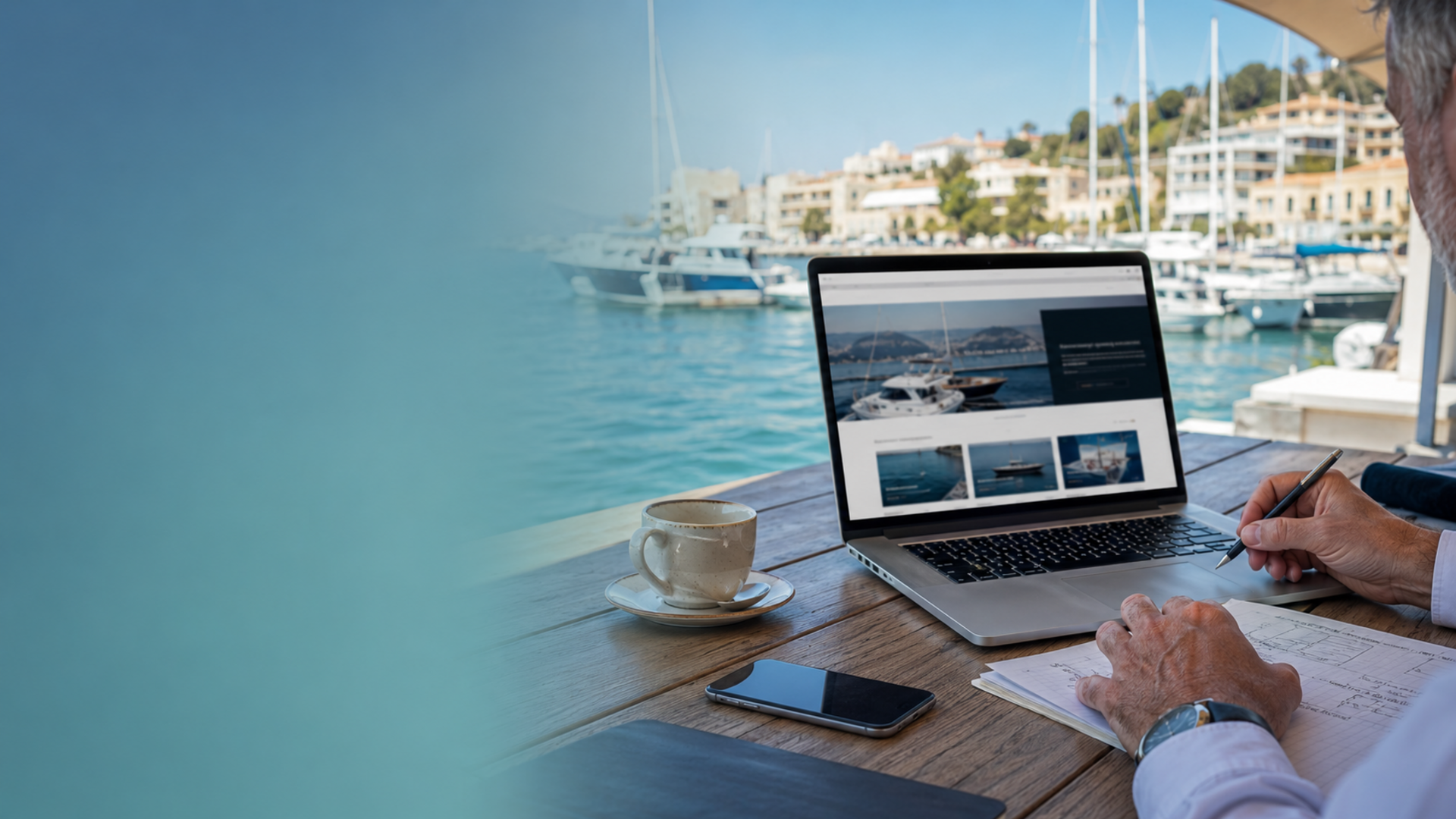
Probado en nuestras propias plataformas marinas
We do not ask workshops to trust a portfolio in the abstract. We operate boatrentalbalearics.com, brokerbarche.com and yachtbrokersgreece.com, and our own enquiry funnels compete for the same urgent and planned searches yours do. When we specify a local-search structure or a review-management cadence in a client programme, it is the version that won on our own platforms after the losing versions cost us real bookings. Standards and market context come from the industry bodies we follow — ICOMIA, NMMA y Infantería de Marina Británica — no es folclore de marketing genérico.
That operating experience is also why our scopes are precise: we know which channels actually book jobs for a given workshop size and service mix, which build the reputation that wins urgent decisions, and which are merely activity, and we quote every proposal itemised against outcomes rather than deliverable jargon. Scope creep is the quiet cost we see most often before a workshop consolidates — a freelancer running ads, nobody managing reviews, and no shared view of which channel actually books a job. We track every enquiry back to the channel that produced it, so the reporting we send is a record of bookings, not a list of posts published.