Marina booking system integration is what turns a marina's website from a static map of pontoons into a berth reservation engine — showing real availability by length and beam, quoting accurately for the dates requested, and confirming a booking without the harbour office answering the phone for every visiting yacht. Most marina websites still show a brochure page and a contact form, forcing every transient berth request through a manual back-and-forth that costs bookings whenever the office is busy or closed for the evening, a gap that only widens once the peak season arrives and the phones never stop ringing. We build berth booking flows that show real availability against a marina's actual berth plan, quote accurately by boat length and duration, and confirm a reservation without staff re-entering it into a separate diary later.
Datos rápidos
- Marina booking system integration by Marine Marketing International starts from €5,500, takes six to nine weeks depending on the berth-management system connected, and is built on WordPress with a live availability map as standard.
- MMI's booking-flow patterns are proven on live charter and brokerage platforms we operate ourselves, so every recommendation is tested before it reaches a marina client.
- A marina running an integrated booking system removes the double-booking risk that comes from managing a berth plan across a whiteboard and a website separately.
- Every MMI marina booking build ships with mobile-first checkout, deposit and payment handling, and enquiry-to-booking tracking as standard.
Why berth booking integration is its own discipline
A skipper approaching an unfamiliar coast wants to know, in the next few minutes, whether a berth is available for their boat's length and beam on the dates they need it. That decision often happens while underway, on a phone with patchy signal, comparing two or three marinas along the same stretch of coast at the same time. The marina that confirms a berth instantly wins that booking; the one that requires a phone call during office hours frequently loses it to whichever marina answered first that afternoon.
The practical consequences follow directly. Availability has to reflect the marina's actual berth plan, length and beam included, because a skipper who arrives to find their confirmed berth cannot fit their boat is a skipper who never returns and tells other sailors why over the following season, often in some detail. Pricing has to account for boat length, duration and season automatically, because a quote that needs a phone call to confirm loses the booking to a marina whose site quotes instantly instead. And confirmation has to update the harbour office's own berth plan without anyone re-entering it by hand, because that manual step is exactly where double-bookings happen during the busiest weeks of summer, when the office is least able to absorb the extra work.
Consider two marinas on the same stretch of coast. The one running an integrated booking system confirms a transient berth in minutes, any hour of the day, with payment already taken. The other requires a call to the harbour office during working hours and a wait for confirmation — a process that loses bookings to competitors every single week of the season, particularly from skippers arriving from abroad in a different time zone entirely, unaware that the office has already closed for the night.
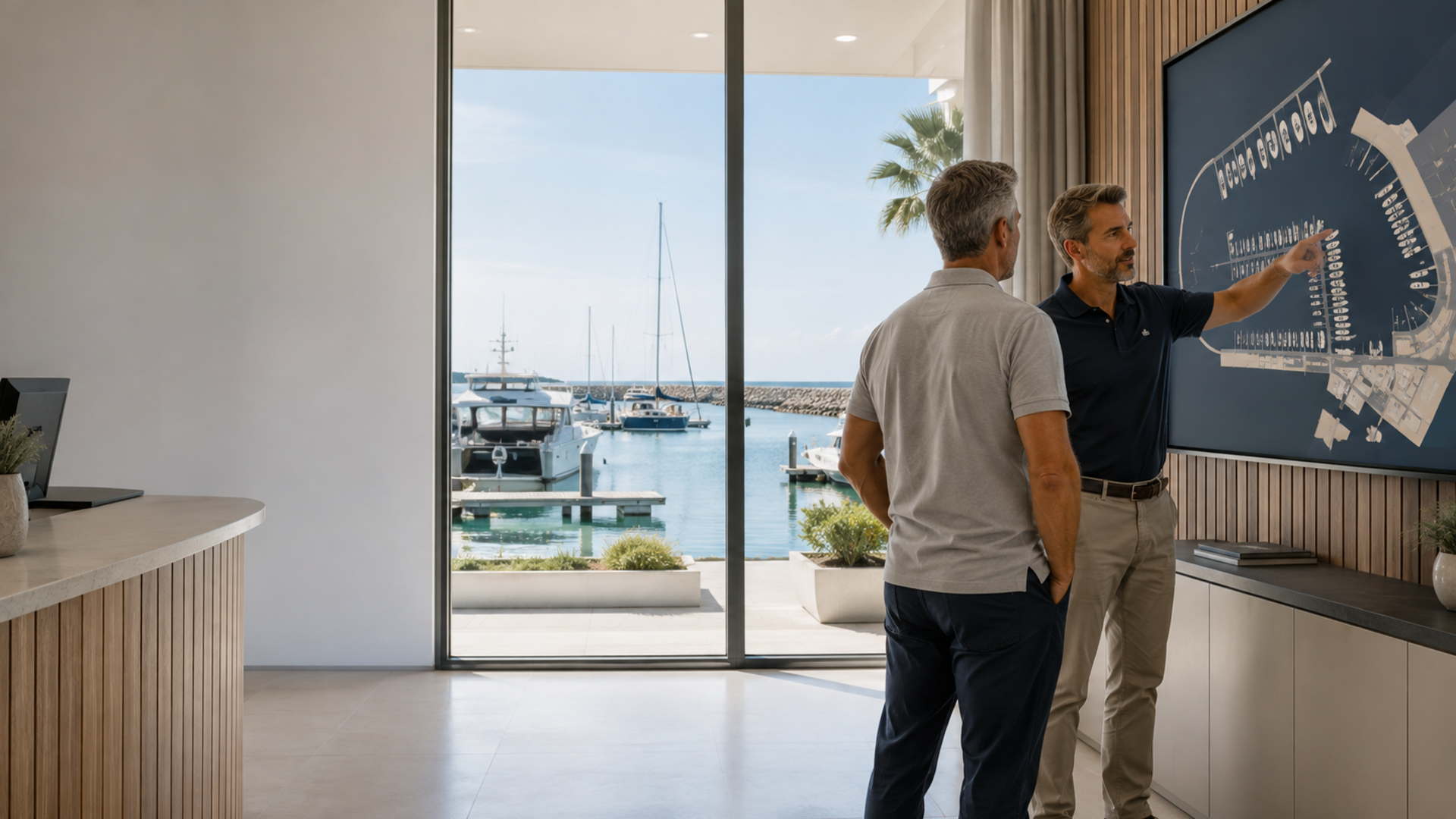
What harbour offices and skippers both need from a booking flow
Harbour offices need one source of truth for berth availability, so the website, the office diary and the physical berth plan never contradict each other under any circumstance. A booking system that requires double-checking a whiteboard has already failed at its one job, however good the rest of the site looks to a first-time visitor.
Skippers need a flow that works from a phone with patchy signal: see available berths for their exact boat, get a real price, pay a deposit, done. Every extra step — a form that leads to a callback, a quote that arrives hours later by email — is a chance for them to book the next marina along the coast instead of waiting around for a reply.
This dual requirement is why this kind of integration cannot be delegated to a generic web-build brief: connecting a berth-management system or a custom availability map to a live, skipper-facing flow is the specialist part of the project, and it is usually the part a generalist agency underestimates or skips entirely, leaving harbour staff to manage the gap by hand every single day.
The anatomy of a booking system that fills berths
A booking system that fills berths rests on specific machinery. A live availability feed connected to the harbour office's berth-management system or a custom-built berth plan, mapped by length, beam and draft. Dynamic pricing that calculates the real total for transient stays automatically, including any seasonal rate variation across the year and any long-stay discounts a marina chooses to offer. A checkout flow built for mobile first, since most skippers book from a phone while underway or moored elsewhere along the coast. And confirmation that updates the harbour office's own system automatically, with no double entry required from a busy team during peak season.
Around that machinery sits the same conversion discipline we apply to every marina build: fast loads, a clear path from browsing to booking, and cookie-consent-safe embedding for any third-party booking widget so the flow never breaks behind a consent banner on a first visit from a mobile browser at sea.

The berth map: your real conversion engine
Most marina enquiries live or die on a single screen: the berth availability map. A skipper who cannot see a real berth for their boat's dimensions leaves to check the next marina along the coast, and rarely comes back once another marina has already confirmed a space for the night. That makes the map the highest-stakes piece of any marina booking system integration project, not a widget bolted onto a brochure page as an afterthought once the rest of the site is finished.
Ours follow a proven anatomy: available berths shown clearly by length and beam, no guesswork required from a skipper scanning quickly on a phone; pricing that updates live as dates and boat size change, so the skipper sees a real number before committing to anything; a deposit and payment step that completes the booking in the same session, because momentum lost to a follow-up call rarely returns once a skipper has moved on to the next option; and confirmation that reaches both the skipper and the harbour office instantly, updating the same berth plan the office already relies on every day.

What a working booking system is worth, in numbers
The commercial case here is not folklore; it is measured. Stanford’s web-credibility research found that around 75% of users judge a company’s credibility from its website design alone, and a broken or manual booking flow undermines that judgment at the exact moment a skipper is deciding where to spend the night, with three other marinas one tap away. Google’s research puts the first visual impression at about 50 milliseconds, and found that 53% of mobile visitors abandon pages that take longer than three seconds to load — a real cost on a berth map most skippers check from a phone while underway with limited patience. For a marina, the arithmetic is direct: a single transient berth booking is often worth a meaningful sum across several nights plus onboard spend, so if a live booking flow converts even a handful of additional bookings a month that would otherwise have gone to a faster-answering competitor, it repays a €5,500–15,000 build within a single season, often well before the season is even half over.
These gains compound across a season. A flow that confirms berths around the clock captures demand a phone-only process simply cannot, particularly from skippers arriving outside office hours or from a different country entirely, unfamiliar with local time zones. Marinas running a properly integrated system report fewer lost enquiries and a lighter administrative load on the same harbour team, week after week through the busiest months of the year.
What an MMI marina booking-system project includes
One accountable package: discovery of your current berth-management system and booking process; integration build connecting live availability, pricing and payment; mobile-first checkout design; consent-safe embedding for any third-party widget; testing across devices and connection speeds to confirm no double-booking risk under real conditions; and training for your harbour team on the new flow before it goes live. Projects start from €5,500 and are priced fixed, in writing, before work begins.
After launch, most marinas keep us as their outsourced marketing department — refining the flow, running seasonal campaigns, and improving conversion monthly. Read nuestra historia to see why that stewardship model exists, or start with a straightforward conversation about your berth plan.

Proven patterns from our own platforms
We do not ask marinas to trust a portfolio in the abstract. We operate boatrentalbalearics.com, a live charter platform taking real bookings, and the same booking-flow discipline, live availability, instant quoting, automated confirmation, carries directly across to marina berth reservations without needing to be reinvented. When we recommend a provider connection or a checkout sequence, it is the version that won on our own bookings after the losing versions cost us real guests and real revenue. Standards and market context come from the industry bodies we follow — ICOMIA, Infantería de Marina Británica y Industria Náutica Europea — not generic marketing folklore repeated from a template.
That operating experience is also why our scopes are precise: we know which parts of a berth-booking build actually prevent double-bookings, which produce reservations, and which are merely nice to have, and we quote accordingly, with every proposal itemised against outcomes rather than deliverable jargon. Our wider work on marina website design shares the same conversion standard, applied to whichever berth-management system a marina already runs day to day.