Content marketing for marine mechanics decides whether your website earns organic traffic and trust over years, or stays invisible to buyers researching a purchase until they stumble onto a competitor’s article instead. A one-off blog post proves nothing; content marketing for marine mechanics has to be structured as a compounding editorial programme — a maintenance guide that answers real questions, a publishing calendar that builds topical authority over months, and distribution that gets each piece in front of buyers who are actually researching, not just publishing and hoping. Marine Marketing International runs content marketing for marine mechanics as a complete system: research, write, publish and distribute, so the content on your site earns its place in search results and in buyers’ decisions. We operate boatrentalbalearics.com, brokerbarche.com and yachtbrokersgreece.com, so every editorial approach recommended here is tested on our own organic traffic, not theorised.
Fast facts
- Content marketing for marine mechanics by Marine Marketing International starts from €4,500 for strategy and initial content build, with ongoing management typically €1,000 to €2,500 a month.
- MMI operates its own marine platforms — boatrentalbalearics.com, brokerbarche.com and yachtbrokersgreece.com — so every editorial approach we recommend is proven on live organic traffic first.
- A maintenance guide only earns trust if it actually answers the question buyers are searching for; content marketing for marine mechanics has to start from real search intent, not a content calendar filled for its own sake.
- Every MMI content marketing for marine mechanics programme ships with a distribution plan, so published articles reach buyers, not just search engines.
Why content marketing matters for marine mechanics
A website does not earn organic traffic by existing, it earns it by answering the questions buyers actually type into search engines before they ever reach out. Content marketing for marine mechanics has to be built around those real questions: a maintenance guide that resolves a specific research need, an editorial calendar that builds coverage across every stage of the purchase, and distribution that puts each piece in front of the right reader rather than leaving it to be found by accident. Done well, content marketing for marine mechanics turns a website from a static brochure into a growing library of pages that keep earning search visibility long after they are published.
The practical consequences follow from that structure. Articles need to be genuinely useful enough that a reader finishes them and trusts the source, not thin filler written to hit a word count. A maintenance guide works because it resolves a real decision point, not because it exists. And distribution — email, social, internal linking — determines whether a well-researched article reaches buyers in the first month or sits unread for a year.
Consider two businesses publishing the same volume of content. The one running content marketing for marine mechanics as a structured programme builds compounding organic traffic and trust, because every article, guide and maintenance guide is built around real search intent. The other publishes a similar number of posts, but a much smaller share are ever found, read or trusted by buyers. Over a year, that gap widens: the structured programme keeps adding pages that rank, while the unstructured one keeps starting from zero with every new post.
What makes content that earns trust, not just clicks
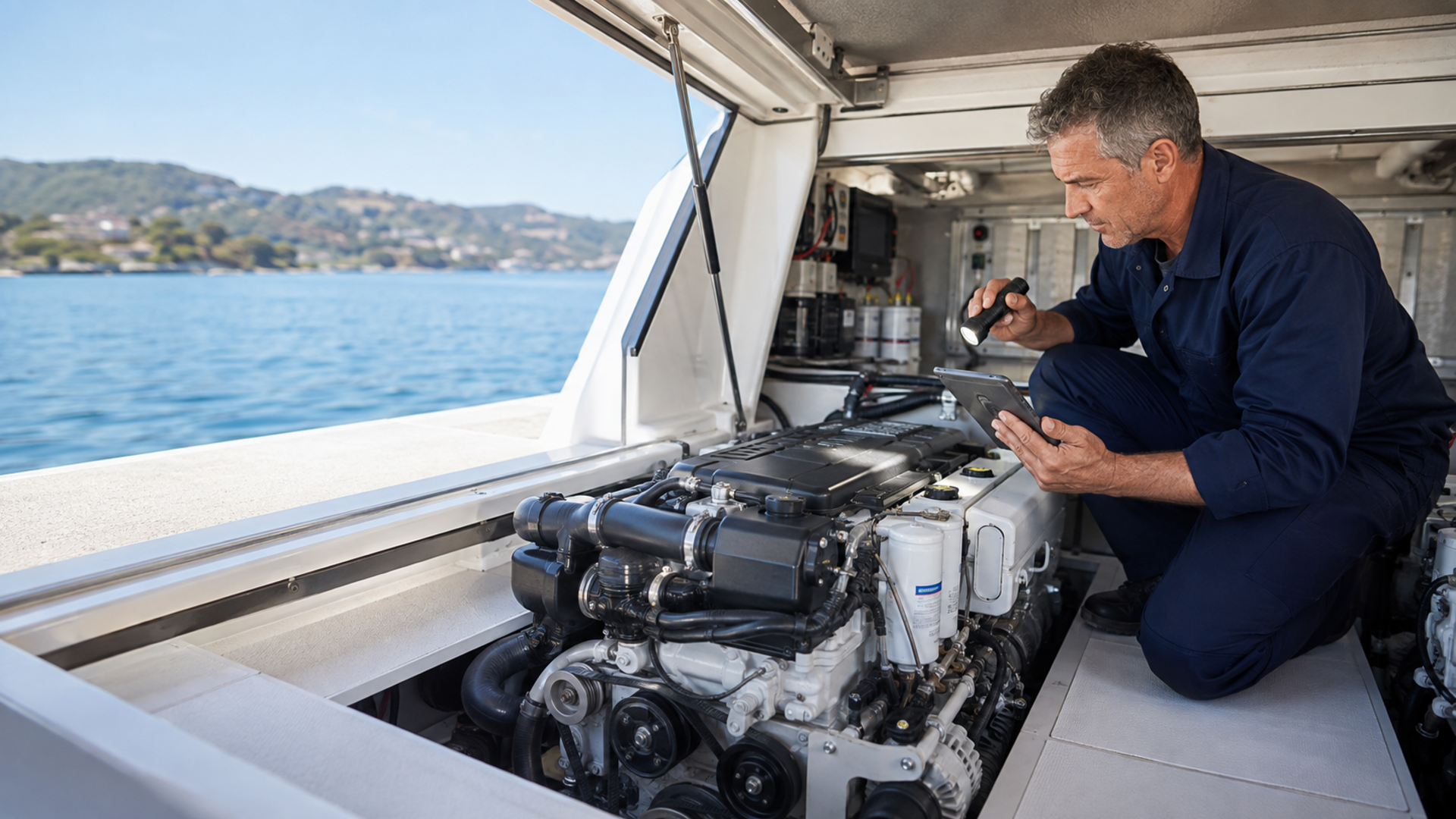
Buyers researching a purchase rarely trust the first result they click. What earns that trust is an article that demonstrates real expertise — specific, accurate, useful — rather than generic advice that could apply to any business in any industry. A maintenance guide that gets the detail right does more for credibility than ten shallow posts.
Distribution closes the gap between publishing and being read: an article shared to the right email list or social channel in its first week earns materially more of the readers it deserves than one left to organic discovery alone. Content marketing for marine mechanics that skips distribution loses most of the value of the research that went into writing it.
This dual requirement, earning trust through genuine expertise and then making sure it gets read, is why content marketing for marine mechanics cannot be delegated to a generic blogging schedule. The topic selection, research depth and distribution sequencing that matter are specific to how buyers actually research a purchase and rarely understood outside specialist marine content.
Seasonality compounds this further. Search interest in particular topics shifts through the year around the sailing season and major industry events, and a content calendar left static misses both the seasonal surges worth reinforcing with timely maintenance guides and the quiet periods where evergreen content matters more than fresh publishing. Reviewing and adjusting the calendar against that seasonal pattern, rather than publishing at the same rhythm year-round, is part of what separates a managed programme from a set-and-forget one.
The anatomy of a content programme that compounds
The trust-winning machinery of content marketing for marine mechanics is specific to repair expertise and buyer research. Topics chosen from real search demand, so every article answers a question buyers are actually asking. A maintenance guide built around genuine research — specific, checkable, useful — not a thin gate for an email address. Distribution sequences that put each piece in front of buyers through email and social, not a blanket publish-and-hope approach. And internal linking that connects every article back to the pages that convert, so organic traffic has somewhere useful to go.
Around that content sits the technical layer: fast-loading article pages, because a slow page loses the reader before the research is even seen, and a site structure that lets search engines find and rank new content quickly. This is where our marine website design work and our content marketing work overlap deliberately: a site built to convert makes every article worth more.

The editorial engine: your real authority asset
Most marine mechanics content marketing is wasted on sporadic posting when the real authority asset is a segmented editorial engine: topics matched to real search demand, maintenance guides that earn contact details and trust simultaneously, and a distribution sequence that carries each article to the readers most likely to act. Content marketing for marine mechanics that treats the editorial engine as the foundation outperforms a blog updated only when someone remembers to write something.
Ours is engineered around a proven anatomy: topics researched tightly enough that every article answers a real question; maintenance guides updated as the season and market shift; distribution sequences that expand every week as the content library grows; and internal linking that ranks every article by its real contribution to enquiries, not just page views. Around the content sits machinery readers never see: SEO structure on every article, a CRM that attributes each enquiry to its source content, and monthly reporting that shows which articles are actually converting readers into enquiries.
What better content marketing is worth, in numbers
The commercial case for professionally managed content marketing for marine mechanics is not folklore; it is measured. Stanford’s web-credibility research found that around 75% of users judge a company’s credibility from its website design and content alone, and an article that fails that first test loses the reader’s trust before the expertise is even absorbed. Google’s own research puts the first visual impression at about 50 milliseconds, and found that 53% of mobile visitors abandon pages that take longer than three seconds to load; industry conversion studies consistently price each extra second of delay at roughly 7% of conversions, a cost that compounds directly into readers who never finish an article at all. For marine mechanics, the arithmetic is direct: a single service or repair job can be worth several hundred to several thousand euros, so if better-structured content marketing converts even a handful of additional qualified readers into service bookings each month, it repays the programme cost comfortably, before counting the compounding organic traffic that a well-structured content library earns automatically.
These returns compound in a way sporadic posting cannot. A well-structured programme keeps building organic traffic over time as the content library grows and older articles keep ranking, steadily lowering cost per qualified reader, while a static or abandoned blog drifts the opposite direction as competitor content and search algorithms move on. Businesses that invest in ongoing content marketing find their organic traffic and cost per enquiry both improve steadily as the programme matures.
The same arithmetic works in reverse. A marine mechanics business publishing occasionally with no distribution strategy is not simply under-publishing, it is leaving organic search visibility on the table that a better-structured content programme would have captured. That loss rarely shows up as a single quiet month; it shows up as a slowly shrinking share of buyers who ever find the site through search at all.
What an MMI project includes
One accountable service: topic research matched to real search demand; maintenance guides built around genuine expertise; distribution sequences tied to email and social; internal linking and SEO structure; ongoing testing and refinement; and monthly reporting tied to organic traffic and enquiries, not just published post count. Strategy and initial content build starts from €4,500 with management typically €1,000 to €2,500 a month, priced fixed and quoted in writing before work begins.
After the initial build, most marine mechanics businesses keep us managing the editorial calendar monthly, refreshing topics as the season and market shift and refining distribution as the data accumulates. Read our story to see why that stewardship model exists.
Proven on our own marine platforms
We do not ask marine mechanics businesses to trust a portfolio in the abstract. We operate boatrentalbalearics.com, brokerbarche.com and yachtbrokersgreece.com, and our own editorial content competes for the same buyers yours does. When we specify a topic structure or a distribution strategy in a client account, it is the version that won on our own platforms after the losing versions cost us real organic traffic. Standards and market context come from the industry bodies we follow — ICOMIA, British Marine and National Marine Manufacturers Association — not generic marketing folklore.
That operating experience is also why our scopes are precise: we know which content formats actually earn organic traffic for a given marine mechanics business and its repair expertise mix, which maintenance guides produce readers who convert rather than vanity page views, and which are merely activity, and we quote every proposal itemised against outcomes rather than deliverable jargon. We track every enquiry back to the article that produced it, so the reporting we send is a record of readers who converted, not a list of posts published.