Google Ads for marinas decides whether your berth-availability budget converts high-intent boat owners into signed contracts, or quietly burns spend on searches that were never going to book a berth. A marina's availability changes by season and by berth size, and generic PPC management — one broad campaign and a single contact page — wastes budget on searches that do not match what is actually free this month. Marine Marketing International runs Google Ads for marinas as a tightly structured system: campaigns built around real search intent by berth length and vessel type, landing pages matched to the exact ad a boat owner clicked, and conversion tracking that shows which keywords actually produce signed berth contracts, not just clicks. We operate boatrentalbalearics.com, brokerbarche.com and yachtbrokersgreece.com, so every campaign structure recommended here is tested on our own live spend, not theorised.
Fast facts
- Google Ads for marinas by Marine Marketing International starts from €4,500 for campaign build, with management typically €1,000 to €2,500 a month plus ad spend billed at cost.
- MMI operates its own marine platforms — boatrentalbalearics.com, brokerbarche.com and yachtbrokersgreece.com — so every campaign structure we recommend is proven on live spend first.
- A marina's berth availability shifts by season and vessel length; Google Ads for marinas has to be structured around that turnover, not a static campaign built once and left alone.
- Every MMI Google Ads for marinas campaign ships with conversion tracking tied to enquiries and signed berth contracts, not just clicks and impressions.
Why Google Ads for marinas is its own discipline
A marina does not sell one product, it sells a rotating set of berths by length and depth, and a single broad campaign pointed at a generic homepage cannot match the specific intent behind a search for a particular berth size or annual mooring rate. Google Ads for marinas has to be structured around that specificity: campaigns segmented by berth length and vessel type, ad copy that matches the exact search, and landing pages that show the berths a boat owner actually searched for, not a generic availability page.
The practical consequences follow from that structure. Keyword targeting needs to reflect real owner search behaviour — by berth length, marina amenity and season — rather than generic terms that waste spend on unqualified clicks. Negative keywords need constant maintenance, because a marina's ads can easily be shown for searches with no commercial intent if the account is not actively managed. And Quality Score, which directly affects cost per click, depends on landing page relevance, so a mismatched page quietly inflates every click's cost.
Consider two marinas spending the same monthly budget. The one running Google Ads for marinas as a structured system spends efficiently because Quality Score is high and every click lands on a relevant page, converting a larger share of that spend into signed contracts. The other runs broad, loosely targeted campaigns, pays more per click due to poor Quality Score, and converts a smaller share of a larger spend.
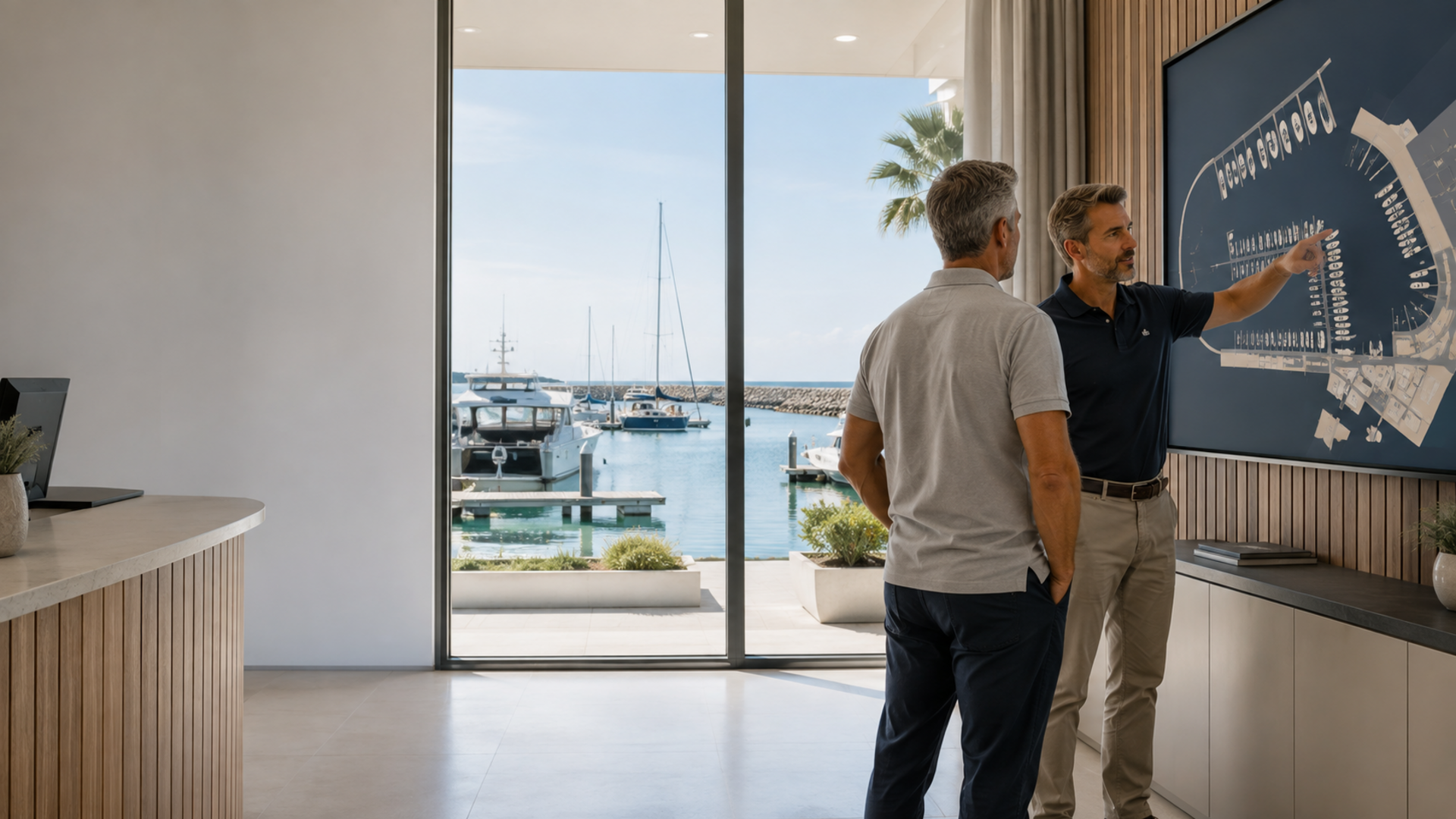
What Google and boat owners both need to see
Google's ad auction rewards relevance: a tightly themed ad group, ad copy that matches the search, and a landing page that delivers on the ad's promise all lift Quality Score and lower cost per click. An account built without this structure pays more for every click regardless of budget size, because the auction penalises mismatch directly.
Boat owners clicking an ad need the same match, delivered instantly: the berths promised in the ad copy, current rates, and a clear way to enquire without hunting through an unrelated availability page. Google Ads for marinas that wins the click but loses the owner on a mismatched landing page is only half finished, and it is the more expensive half to get wrong since the click was already paid for.
This dual requirement, satisfying both the auction and the owner, is why Google Ads for marinas cannot be delegated to a generic PPC template. The keyword patterns, landing page structure and negative-keyword discipline that matter are specific to seasonal berth turnover and rarely understood outside it.
Seasonality compounds this further. Search volume for specific berth lengths and seasonal moorings shifts through the year as owners plan for spring launches or winter storage, and a campaign left on autopilot misses both the seasonal surges worth bidding harder into and the quiet periods where budget should pull back. Reviewing and adjusting bid strategy against that seasonal pattern, rather than running a flat monthly budget regardless of demand, is part of what separates a managed account from a set-and-forget one.
The anatomy of a campaign that converts, not just clicks
The conversion-winning machinery is specific to marina availability. Campaigns and ad groups structured by berth length and vessel type, so no search competes against an unrelated berth size. Landing pages matched to each ad group, showing the exact berths a boat owner searched for. Negative keyword lists maintained weekly, so budget stops leaking to irrelevant searches. And conversion tracking that follows a click through to an enquiry and, wherever possible, a signed contract, so optimisation is based on revenue signals, not just click-through rate.
Around that machinery sits the technical layer: fast-loading landing pages, because Google penalises slow pages in both Quality Score and the owner's patience, and clear enquiry forms that keep momentum from an expensive click. This is where our marine website design work and our Google Ads work overlap deliberately: a marina site built to convert makes every paid click worth what it costs.

The campaign structure: your real revenue engine
Most marina ad spend is wasted on a single broad campaign when the real revenue engine is a tightly segmented structure: separate campaigns and ad groups by berth length and vessel type, each with its own landing page and negative keyword list. Google Ads for marinas that treats structure as the foundation outperforms accounts built around a handful of generic keywords.
Ours is engineered around a proven anatomy: ad groups themed tightly enough that every keyword in the group shares the same real intent; landing pages that show the exact berths promised in the ad, updated as availability turns over; negative keyword lists that expand every week as new irrelevant search terms are identified; and conversion tracking that follows a click through enquiry to signed contract, not just to a form submission. Around the structure sits machinery boat owners never see: UTM tracking on every ad, a CRM that attributes each enquiry to its source campaign and keyword, and monthly reporting that shows which berth segments are actually converting paid clicks into contracts.

What better Google Ads management is worth, in numbers
The commercial case for professionally managed Google Ads for marinas is not folklore; it is measured. Stanford’s web-credibility research found that around 75% of users judge a company’s credibility from its website design alone, and an expensive paid click that lands on a weak page wastes the spend that earned it. Google’s own research puts the first visual impression at about 50 milliseconds, and found that 53% of mobile visitors abandon pages that take longer than three seconds to load; industry conversion studies consistently price each extra second of delay at roughly 7% of conversions, a cost that hits a paid click twice, once in wasted spend and once in a lower Quality Score. For a marina, the arithmetic is direct: a single annual berth contract can be worth thousands of euros, so if better-structured Google Ads for marinas converts even one additional enquiry into a signed contract per quarter, it repays the management fee many times over, before counting the lower cost per click that a well-structured account earns automatically.
These returns compound in a way an unmanaged account cannot. A well-structured campaign keeps improving Quality Score over time as conversion data accumulates, steadily lowering cost per click, while a neglected account drifts the opposite direction as irrelevant searches and stale ad copy erode relevance. Marinas that invest in ongoing management find their cost per signed berth falls steadily as the account matures.
The same arithmetic works in reverse. A marina running an unmanaged or loosely structured account is not simply spending inefficiently, it is paying a premium for every click through a depressed Quality Score while converting a smaller share of that expensive traffic. That loss rarely shows up as a single bad month; it shows up as a slowly rising cost per enquiry that nobody traces back to campaign structure.
What an MMI Google Ads for marinas project includes
One accountable service: campaign and ad group structure built around berth length and vessel type; landing pages matched to each ad group; negative keyword management; conversion tracking tied to enquiries and signed contracts; ongoing bid and budget optimisation; and monthly reporting tied to cost per signed berth, not just clicks. Campaign build starts from €4,500 with management typically €1,000 to €2,500 a month, priced fixed and quoted in writing before work begins.
After the initial build, most marinas keep us managing the account monthly, refreshing ad groups as availability turns over and tightening negative keywords as the data accumulates. Read our story to see why that stewardship model exists.

Proven on our own marine platforms
We do not ask marinas to trust a portfolio in the abstract. We operate boatrentalbalearics.com, brokerbarche.com and yachtbrokersgreece.com, and our own paid campaigns compete for the same boat owners yours do. When we specify a campaign structure or a negative-keyword pattern in a client account, it is the version that won on our own platforms after the losing versions cost us real budget. Standards and market context come from the industry bodies we follow — ICOMIA, British Marine and European Boating Industry — not generic marketing folklore.
That operating experience is also why our scopes are precise: we know which campaign structures actually sign berth contracts for a given marina size and berth mix, which keywords produce enquiries, and which are merely activity, and we quote every proposal itemised against outcomes rather than deliverable jargon. We track every enquiry back to the campaign and keyword that produced it, so the reporting we send is a record of contract pipeline, not a list of clicks delivered.